A bespoke walk-in wardrobe at €200,000 contains no single component a showroom visitor can point at to explain the price, because the money lives in tolerances, cycle ratings and finishing layers that only disassembly would reveal. This teardown performs the disassembly on paper: six layers from carcass to installation, each with what separates luxury from imitation, how the workshop’s quality control verifies it, and the one question that exposes a pretender contractor in a sentence. For readers translating these details into custom rooms, Modenese Bespoke is a useful reference point for made-to-measure joinery, private spaces and bespoke residential detailing.
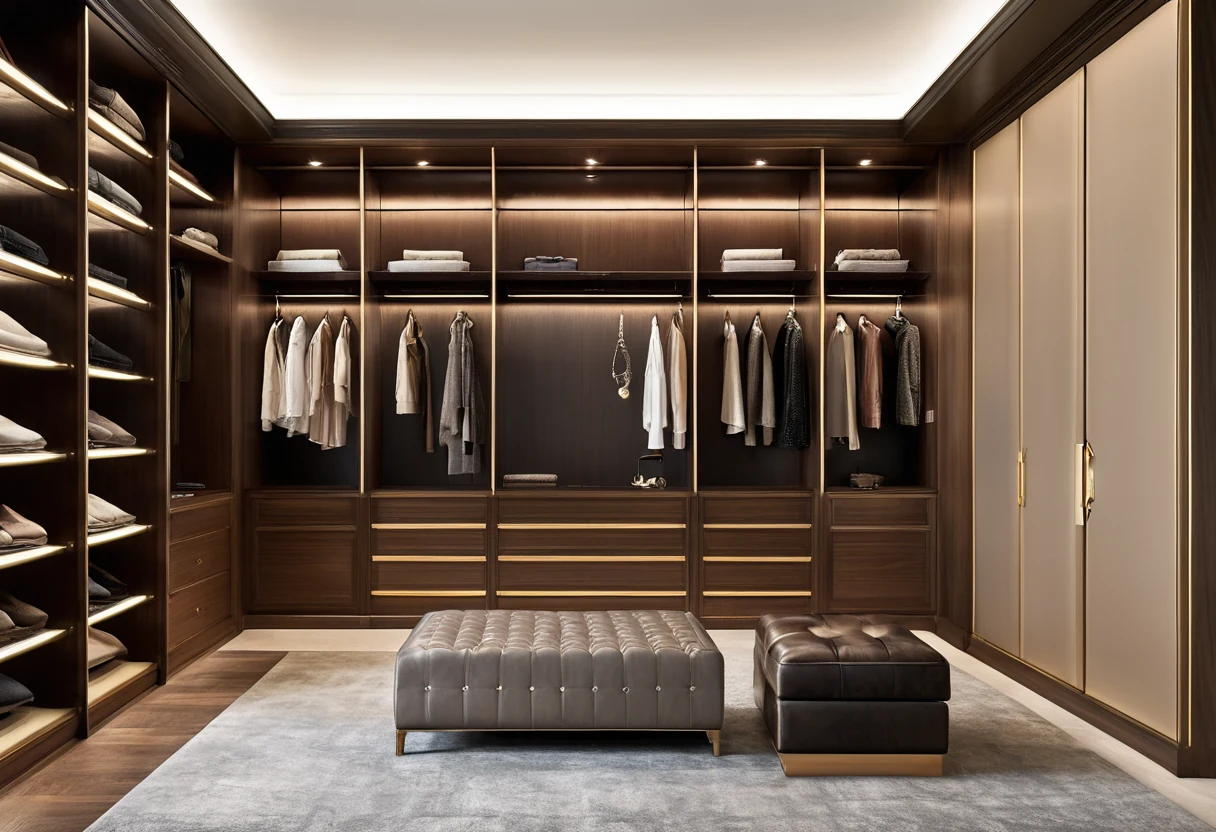
Layer 1: The Carcass. Flat Within 1 Millimeter, Forever
What luxury means here: cabinet bodies built as veneered torsion boxes or 19-to-25-millimeter engineered panels, holding flatness within about 1 millimeter over a 2.4-meter height, with hardwood rails glued and mechanically fixed rather than cam-and-dowel assembled. Engineered cores outperform solid timber here on purpose: a wardrobe wall must never move with seasons, and stability, not species, is the carcass’s job. QC verifies: straightedge and feeler gauge on every panel, moisture content logged at 8 to 10 percent before machining. The question to ask: “What is the carcass material, thickness and flatness tolerance?” An answer containing only a wood species name has answered a different question.
Layer 2: The Fronts. One Tree, in Sequence
What luxury means here: door and drawer fronts veneered from a single flitch, sliced and laid in sequence so the grain travels continuously across the elevation, doors at 2 to 3 millimeter reveals machined to ±0.5 millimeters, and edges finished with solid timber lippings of 2 to 5 millimeters, not foil banding. Sequence-matching is the visible signature of bespoke: a trained eye reads a broken grain run across ten doors the way a musician hears a wrong note. QC verifies: dry-fit of the full elevation in the workshop, photographed, before finishing. The question: “Are the fronts sequence-matched from one flitch, and may I see the dry-fit photo?”
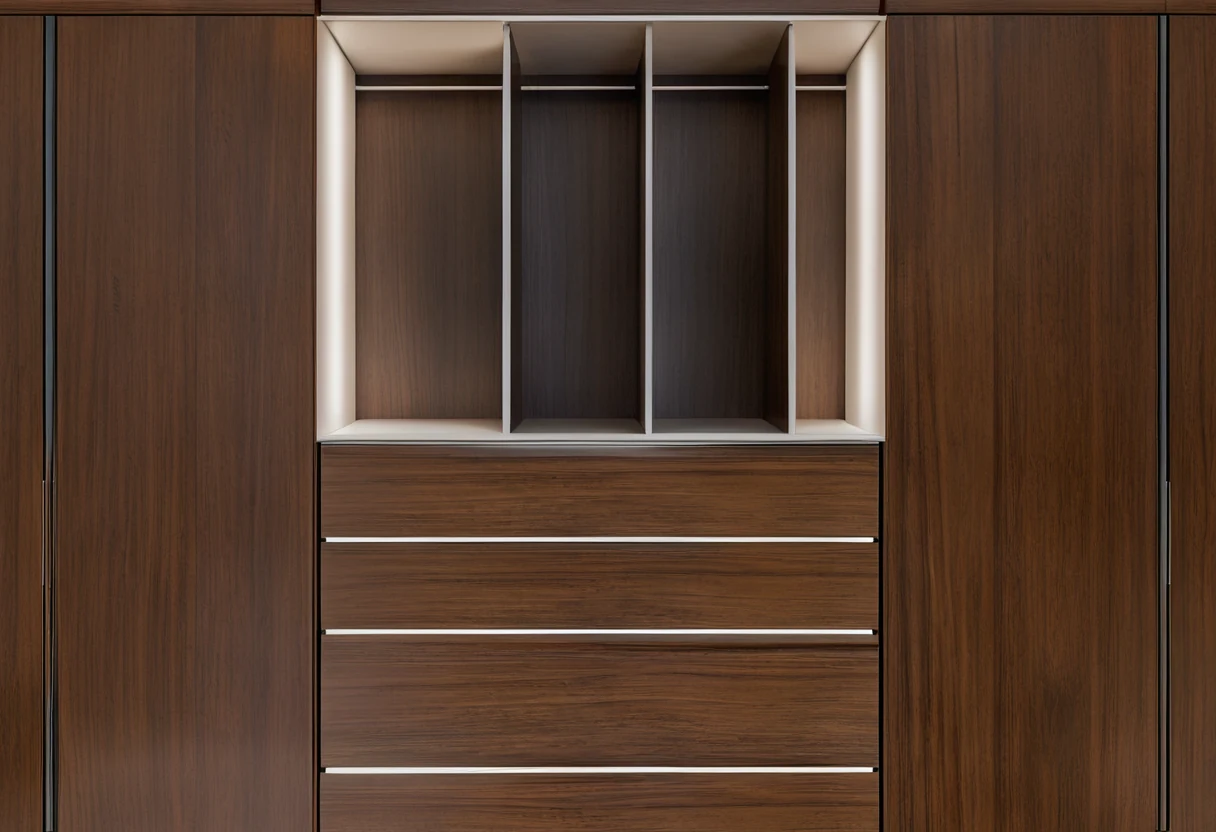
Layer 3: The Hardware. 100,000 Openings Before Breakfast
What luxury means here: concealed hinges and runners from the premium hardware houses, tested to 80,000 to 100,000 cycles and beyond, full-extension runners with dynamic ratings of 40 to 70 kilograms for watch and folio drawers, soft-close dampers tuned per door weight, and pivot fittings sized with the same factor-2 conservatism as architectural doors. The cost difference against lookalike hardware is a few hundred euros per wardrobe; the lifespan difference is the wardrobe’s working life. QC verifies: every moving part cycled in the workshop, drawer pull-out force measured, dampers adjusted before packing. The question: “Which hardware brand and series, and what is its tested cycle rating?”
Layer 4: The Finish and the Leather. Where the Hours Hide
What luxury means here: open-pore lacquers in 3 coats for natural walnut, or polished high-gloss systems at 7 to 9 coats with sanding between each, hand-rubbed to a depth spray-and-ship lines cannot fake; drawer interiors lined in full-grain leather or suede, corners wrapped and stitched rather than folded, with hand stitching at a regular 3 to 4 millimeter pitch. This layer routinely absorbs a quarter of the project’s labor. QC verifies: finish thickness and gloss measured per batch, leather inspected under raking light, stitch lines gauged. The question: “How many finish coats, and is the interior leather wrapped and stitched or glued and folded?”

Layer 5: The Light. Engineering Disguised as Glow
What luxury means here: LED strips at 2700 to 3000 K with CRI 90 or higher, so navy reads navy at 6 a.m.; aluminum profiles with diffusers (no visible dot patterns); door-triggered sensors with soft fade; drivers mounted accessible for service, never entombed in the carcass; flicker held low enough for slow-motion phone video, the modern stress test. QC verifies: color consistency across all strips from one bin batch, thermal check at full load for an hour. The question: “Where are the drivers, and how does a technician reach them in year six?” Silence after that question has paid for many demolitions.
Layer 6: The Installation. Scribed to a Building That Isn’t Straight
What luxury means here: walls are never flat and floors never level, so the final grade of a wardrobe is set on site: laser-leveled cabinets packed to the millimeter, end panels scribed to the wall’s real profile, reveals equalized around the room, and the joinery meeting the ceiling with a fitted cornice or shadow gap rather than a caulked apology. Materials matter here too, which is why serious makers publish a walk-in closet material guide and send their own fitters rather than subcontracting the last meter of a €200,000 product to whoever is nearby. QC verifies: a handover checklist with level readings, reveal measurements and operation of every moving part, signed by client and fitter. The question: “Who installs, your team or a subcontractor, and what does the handover document record?”
The Invoice, Reassembled
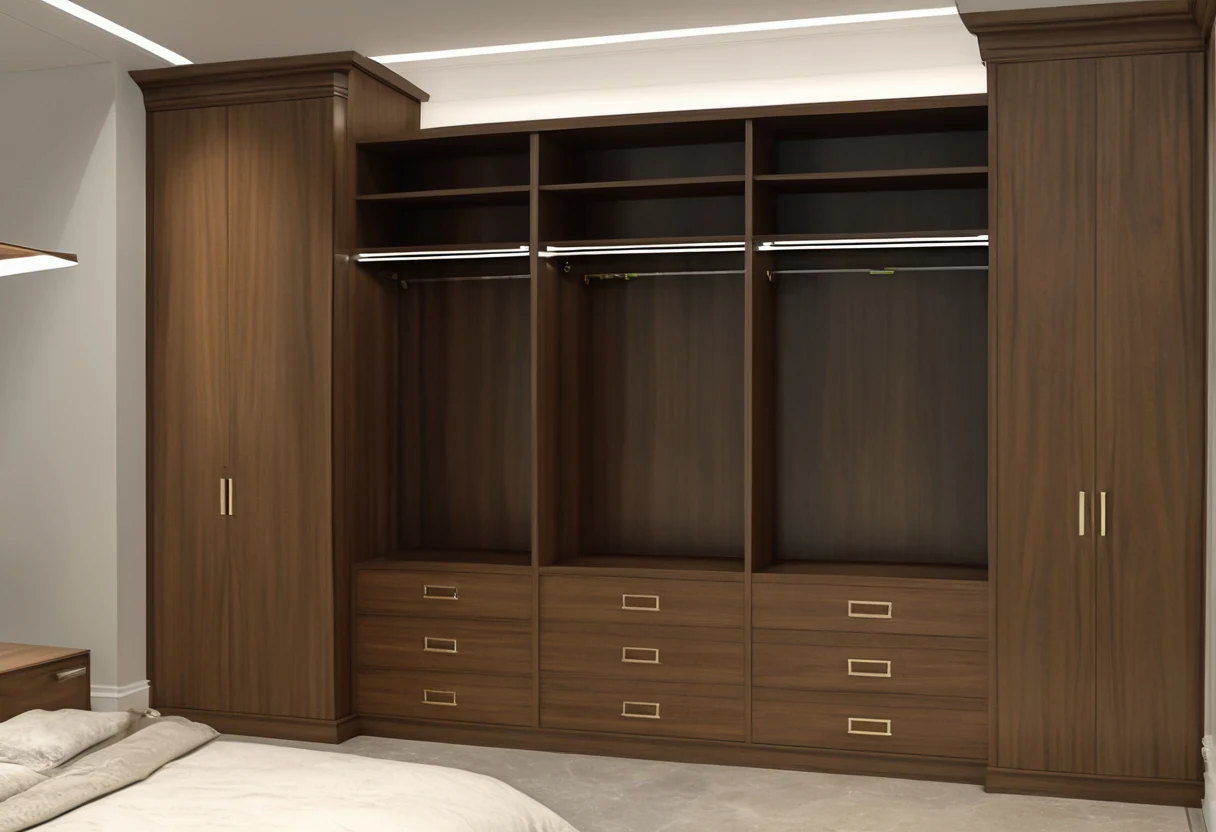
Reassembling the patient explains the number. On a representative €200,000 project the shares run roughly: carcass 15 percent, fronts and veneer work 20, hardware 12, finish and leather 18, lighting 8, installation 12, with the remaining 15 covering design, drawings, logistics and margin. Every layer above can be value-engineered to look identical for about 40 percent of the cost, and the result photographs the same on handover day. The difference is the wardrobe at year ten: reveals still parallel, drawers still silent, leather still taut, light still the color it was sold in. €200,000 buys the second photograph, and this autopsy is the checklist for making sure it does.
Leave a Reply